SANTON MAKERS
Santon Makers
Behind every santon is a santon maker (a santonnier, in French). The craft combines sculpture, mold-making, pottery and miniature painting, and one person often does all four from start to finish. Here’s how a santon is made, and how knowing that changes the way you look at one.
The process, from model to santon
A santon made in a series goes through seven steps. You can see each one on the finished piece if you know where to look.
-
The model
A one-of-a-kind piece, sculpted by hand in clay or wax. It’s the only true sculpture in the process; everything else comes from it. A workshop may spend weeks on a model it will keep making for thirty years.
-
The mold
Made of plaster, usually in two halves. It captures the model so it can be reproduced.
-
Pressing
The clay is pressed by hand into each half of the mold, in a thin layer.
-
Assembly and seam cleaning
The two halves are joined, the seam is smoothed with a sculpting tool, and any details lost in the mold are carved back in.
-
Drying
Slowly, in the open air, for several days to several weeks depending on size and season.
-
Firing
For fired santons. Around 1,740 to 1,830 °F (950 to 1,000 °C), depending on the workshop and the clay.
-
Painting
By hand, one piece at a time. It’s the longest step and the one that sets the price.
The clay
The traditional clay for Provençal santons is a red clay, rich in iron, which gives fired, unpainted pieces (biscuit) their brick color. It’s smooth and easy to shape, and it holds fine detail.
It has to be prepared first: worked into a paste and kneaded to get the air bubbles out. An air bubble left in a piece expands in the kiln and makes the santon burst. It’s the biggest risk in the trade, and the reason thick pieces are hollowed out from underneath.
Some studios don’t fire: the painted unfired clay santon, closer to Lagnel‘s process, is lighter and more fragile. It can’t stand water at all.
The mold
The two-part mold is what makes the trade pay: around 1800, it’s what made santons affordable and helped bring the nativity into ordinary homes.
Plaster molds wear out. The first figures come out crisp; after a few hundred, edges get rounded, folds go soft, and faces lose detail. A careful workshop retires its old molds and makes new ones from the original model. That’s why two santons of the same figure made ten years apart aren’t identical, and why it’s worth comparing several in the same bin before you buy. See how to spot a good santon.
The mold seam along the side is the telltale sign of the process. It should have been cleaned up; if you can clearly feel it with your finger, the piece was rushed.
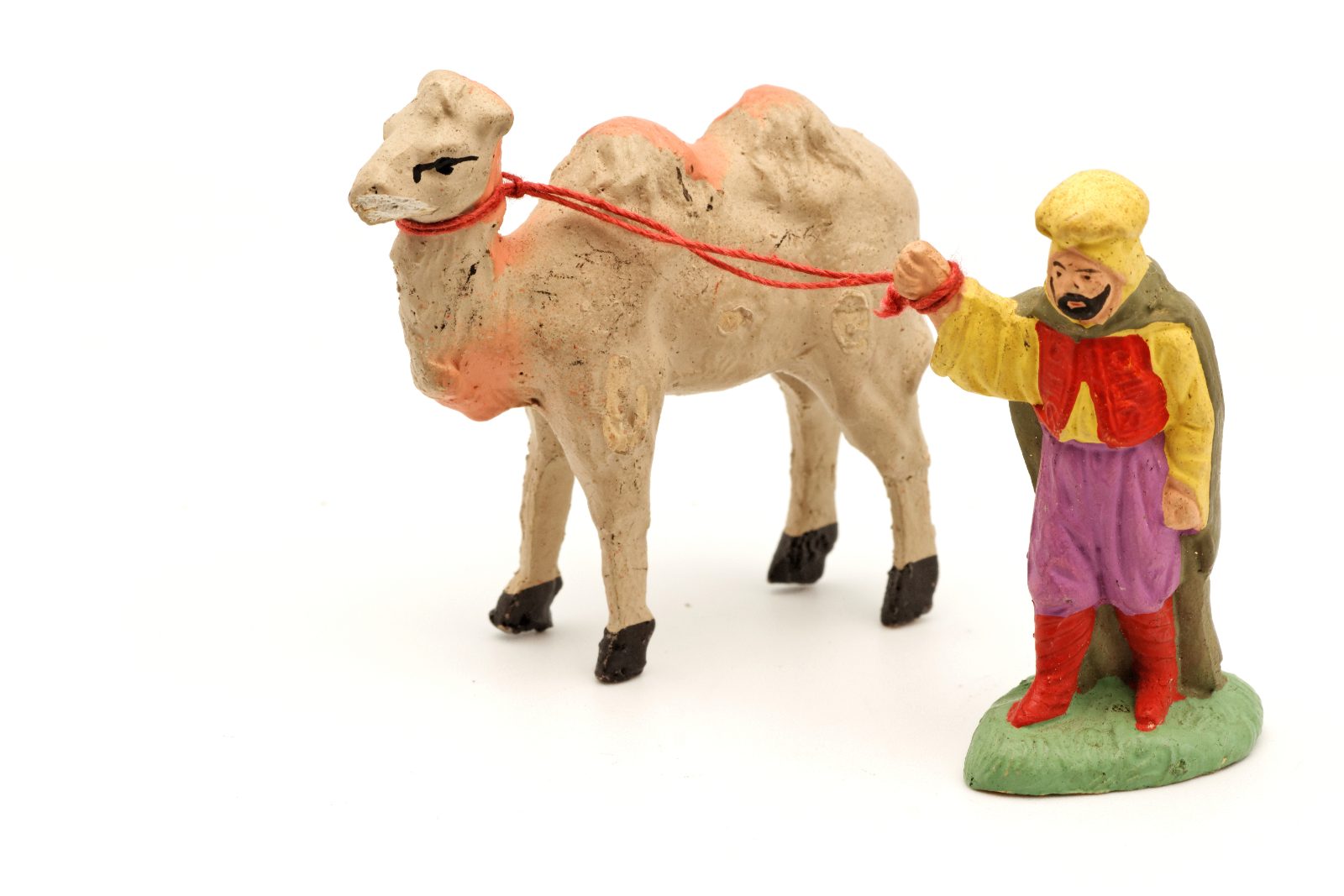
Drying and firing
Drying is slow because it has to be even: a piece that dries faster on the outside than inside will crack. Workshops cover the pieces, turn them, and keep air from moving too fast. In winter, in a barely heated workshop, it can take three weeks.
Firing changes the material for good: the clay becomes ceramic and can never go back. That’s why you can brush off a fired santon, while an unfired one stays fragile forever.
After firing, the piece is the color of the clay. Some workshops stop there and sell it unpainted: a whole nativity in plain fired clay has a quiet beauty that painted figures don’t.
Painting
This is where the real work happens, and it’s the step buyers notice least.
Traditionally with gouache, now often with fine acrylic paint. The painter works color by color rather than piece by piece: all the blues in the batch, then all the reds, then the skin tones, then the details. A 3-inch (7 cm) santon can get fifteen to twenty-five rounds of paint.
The eyes are the make-or-break step. An experienced santon maker paints them in three touches, and that decides whether the figure seems to be looking at something or at nothing. It’s the best quality test you can do with your own eyes.
The finish is matte, by tradition and for a practical reason: under a nativity’s low, warm lighting, a glossy surface catches a bright spot that flattens the shape.
Dressed santons
A craft within the craft, and often a second person in the workshop.
How it works: the head, hands and sometimes the feet are painted terra-cotta; the rest is a frame (wire, wood, stuffed fabric) dressed in real fabric, cut and sewn to scale. The fabric is chosen for its pattern and the way it hangs: a print that’s too big on a 5-inch dress ruins the illusion, and fabric that’s too thick won’t fold naturally. Many workshops use old textiles, because the fibers have softened with age.
That explains the price, and also why they’re fragile: fabric fades in light, collects dust and doesn’t like humidity. See caring for dressed santons.
Meeting the studios
Working santon studios. Name, town, area and website: see the santon maker directory. Are you a santon maker who isn’t listed? The submission form is at the bottom of the directory page, and listing is free.
Three ways to meet them, best first:
- The workshop itself. Many santon makers keep a shop next to their workshop open all year and are happy to explain what they do. In the off-season they have time to talk, so that’s the best time to go.
- Santon fairs. Marseille’s dates back to 1803 and is still the best known, but there are fairs in many towns in Provence and well beyond, even outside France. And they aren’t just in December: the 2026 season runs from September 19 to January 3, 2027. See the santon fair calendar.
- Museums and collections. Several regional museums have old nativities and collections of santibelli (old painted plaster figures); some churches display huge nativities from December to Candlemas.
A question that always gets the conversation going: ask a santon maker which figures they sculpted themselves. Almost all of them have one or two characters of their own, not handed down from tradition. Those are the ones they love talking about.
Know a workshop that should be listed, or run one? Write to us. We only list santon makers we’ve been able to verify, with a website of their own.