SANTONS
Nativity Scene Characters
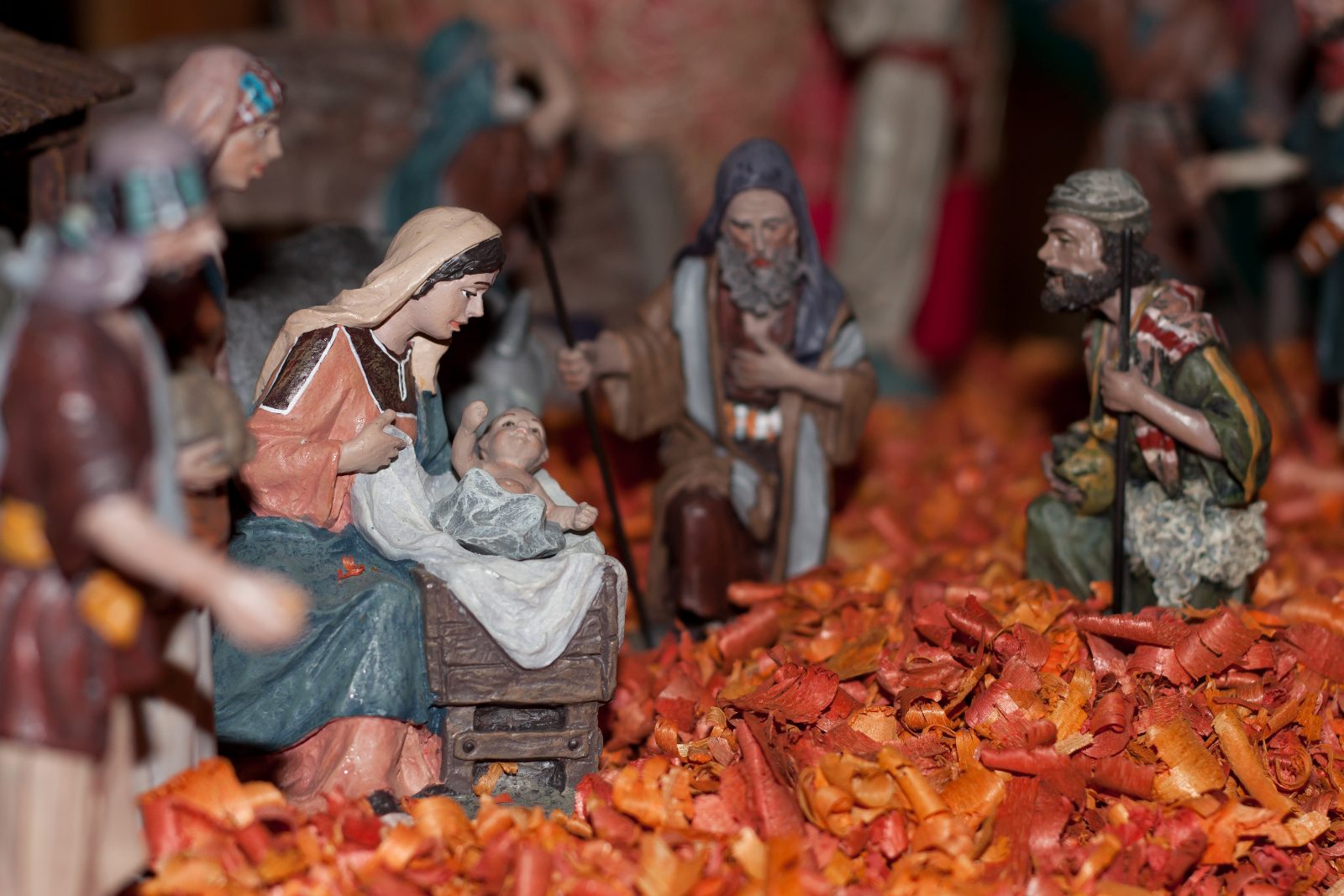
You only need six figures to tell the Christmas story. A Provençal nativity can have a hundred, and that’s what makes it so special: it brings a whole village into the scene, with its tradespeople, its old folks and its outsiders. Here’s who they are and why they’re there.
The core: the Nativity
- The Infant Jesus
- Lying in the manger, the original meaning of the word “crèche.” Traditionally, he isn’t placed in the scene until Christmas Eve, and the manger stays empty until then. Many families let the youngest child put him in.
- Mary
- Kneeling or leaning over the manger, almost always in blue and white. There’s no fixed rule for which side she goes on.
- Joseph
- Standing, often leaning on a staff, sometimes holding a lantern, the scene’s light before electric lights. Usually in brown, tan or dark green.
- The ox and the donkey
- They’re not in the Gospels. They come from an apocryphal text and a reading of Isaiah. Tradition says they kept the Child warm with their breath. Place them behind the manger, heads bowed toward it.
- The Gloria angel
- Hanging above the stable, banner unfurled. He’s the only santon that doesn’t touch the ground, so plan where to hang him while you build, not after.
The Magi
Melchior, Caspar and Balthazar. They’re not part of the Christmas night scene. They arrive later, and their arrival is a moment of its own.
The most popular family custom is to set them far away on December 25, at the edge of the nativity, and move them an inch or so closer each day until Epiphany, January 6 (or Epiphany Sunday in U.S. parishes), when they finally reach the stable. For kids, that’s twelve days of storytelling just by moving a figure. Details in arrangement.
If you have a camel, keep it back with the servant. A camel right in front of the stable throws off the scale of everything else.
Where their names come from, the three gifts and Epiphany are covered on the Wise Men page.
The Provençal village
These are the villagers, as opposed to the figures from the Gospel. Several come from the pastorales, Christmas plays performed in Provençal, where they have a personality and sometimes a famous line. Others, like the washerwoman, aren’t in the plays and come from the old village trades. Each one has its own page.
- The ravi
- Arms raised to the sky, mouth open. The most recognizable of all. He’s often called the village simpleton, but it’s more accurate to see him as the one overwhelmed by the news, the only one whose reaction matches how big it is. Place him where everyone can see him, near the stable.
- The tambourinaire
- A galoubet (a three-hole flute) in one hand, a tambourin drum in the other. He plays music for the procession, often leading the way.
- The boumian
- The Bohemian wanderer, off to the side, sometimes with a hen under his arm. The villagers don’t trust him in the pastorales, but he joins them in the end. Place him at the edge, never in the main procession.
- Pistachié
- The bragging, talkative farmhand, the comic relief of the pastorales. You’ll know him by his swagger.
- The blind man and his son
- One of the most moving pairs: the old man led by his son, who regains his sight when he reaches the stable. Always shown together, on the road.
- The washerwoman
- Kneeling at the washing spot. She’s the reason to add water to your scene. See the fountain.
- The shepherds and the lamb
- The first to hear the news, so the first to arrive. The shepherd carrying a lamb on his shoulders recalls the pastrage, a lamb offering still made in several villages at Midnight Mass.
- The elders
- Grasset and Grassette with their umbrella, Monsieur Jourdan and Margarido on her donkey, Roustido with his lantern. Dressed in their Sunday best, bickering, and always last on the road. They’re the group that gives the nativity its charm.
- The Arlésienne and the gardian
- The only couple on horseback, and the only one that comes from a poem rather than a play. She doesn’t bring a gift. She brings the traditional dress of Arles.
- The monk
- Francis of Assisi, in his brown habit. He’s not just another villager: santon makers see him as their patron, and including him is a nod to the craft itself.
- The boules player
- Crouching to aim, leaning in to throw. They’re clearly busy with something other than the Nativity, and that’s exactly what makes a Provençal nativity so charming.
The old trades
This is the group that keeps growing. A santon maker can create any trade, but these are the classics:
- The miller, a sack of flour on his shoulder. Place him near the mill, of course.
- The fishmonger and the fishwife, basket of silvery fish.
- The baker, with his peel and loaves, in front of the oven.
- The knife grinder, bent over his wheel.
- The basket maker, surrounded by baskets.
- The hunter, gun under his arm and dog at his feet.
- The flower seller, the garlic seller, the water carrier.
- The mayor, the priest, the schoolteacher: the village’s three authority figures, often shown with a touch of humor.
Every tradesperson needs a setting. A knife grinder on his own is just a figurine. Put him in front of a shed door with two knives on a chopping block, and you have a scene. Plan the setting before you buy the santon, not the other way around.
Elsewhere in the world
The characters change from country to country:
- Catalonia: the caganer, a squatting figure hidden somewhere in the scenery. Recorded since the 17th century, he stands for the fertile earth. Kids love trying to find him.
- Naples: the presepe is full of tavern keepers, musicians, fish sellers and even modern-day figures. See the Neapolitan nativity.
- Latin America: the nacimiento adds local plants and animals, and sometimes village characters. In Mexican-American homes from Texas to California, it’s often the centerpiece of Christmas.
- Poland: the Kraków szopka swaps the landscape for the city’s own landmarks.
- Alpine Provence, Alsace, Quebec: each region dresses the same figures in its own clothes and trades. In America, the Moravian putz of Pennsylvania and North Carolina does the same with its miniature villages.
Adding a figure from where you live doesn’t break tradition. It’s exactly what the tradition has always done. A lobsterman in Maine, a rancher in Montana: the santon makers of Provence would understand.
What order to buy them in
A nativity that grows over ten years is better than one bought all at once. Here’s an order that works:
-
Year 1
Mary, Joseph, Baby Jesus, the ox and the donkey. Your scene is complete.
-
Year 2
A shepherd, a sheep or two, and the angel. Now the scene has witnesses.
-
Year 3
The ravi and the tambourinaire. The village begins.
-
Year 4
The three Wise Men, all at once. Don’t split them up.
-
After that
One or two tradespeople a year, chosen to match the scenery you built that year. That’s what makes a nativity feel like a family heirloom, not a catalog.