SANTONS
Where to Buy Santons
There are five ways to buy santons, and they offer very different pieces at very different prices. This page explains the pros and cons of each, what to check before you pay, and a few questions that turn a purchase into a real conversation with the maker.
Five ways to buy
| Channel | What you gain | What you lose |
|---|---|---|
| The studio | The full range, the explanations, the option to order | You have to get there |
| The santon fair | Several studios compared in an hour | Crowds, and a selection sometimes limited to best-sellers |
| The specialty shop | Advice, availability year-round | A middleman’s markup, the retailer’s selection |
| Secondhand | Old pieces, sometimes excellent, at low prices | No guarantee, frequent breakage, mismatched ranges |
| Online | Access from anywhere | You can’t hold the piece in your hand: the main quality test disappears |
The studio
It’s the best option, and often not the most expensive: buying straight from the santon maker cuts out the middleman.
Many workshops have a shop next door that’s open year-round. Go in the off-season (spring or September): the maker has time to talk, the workshop is busy, and you can see pieces being made. In December, everyone is swamped. If you’re planning a trip to Provence, it’s one more great reason to go in the spring.
What you can only do there: ask for a specific piece, fill out an older collection, get a broken figure repaired, and learn why each character carries what he carries. See the santon maker’s craft.
The fair
Santon fairs run from mid-September to early January. The 2026 season opens on September 19 and closes on January 3, 2027, and many fairs take place in the fall. The full calendar of santon fairs has all the season’s dates, places and hours. Marseille’s fair goes back to 1803, and there are fairs in towns and villages across Provence and beyond, even outside France, like the Fira de Santa Llúcia in Barcelona for pessebre figures.
Three tips:
- Walk the whole fair before you buy. The same character can look very different from one booth to the next.
- Bring one of your santons in a box to compare size and style. Two “7 cm” figures from different makers can differ by a few millimeters.
- Write down the maker’s name for every purchase in your inventory. You’ll want to go back.
Dates and places change every year, so check locally before you go.
Secondhand
Flea markets, yard sales, estate sales, online auctions, family heirlooms. That’s where you’ll find older pieces, sometimes for next to nothing because the seller doesn’t know what they have. In the U.S., estate sales and online auctions are where most old santons turn up.
- Buy in lots rather than one at a time. Lots cost less and often hold a nice surprise or two.
- Check for repairs. A head glued back on crooked or a dark ring around a joint are signs of a sloppy super glue job. See repairing a break.
- Watch out for repainting. Bright, fresh paint on an obviously old piece lowers its value.
- Mismatched sets are the real risk. Ten santons from four makers in three sizes will never make a good nativity. See collecting.
Online
For most of our readers in the U.S., an ocean away from the nearest workshop, this is often the only option.
To play it safe:
- Buy from the maker’s own website when there is one, rather than from a big marketplace. Many santon makers ship to the U.S. Ask before ordering, and order by late October if you want them by Christmas.
- Ask for real photos, not catalog images. Ideally, a photo of the exact piece you’ll receive.
- Check the size and ask whether it’s measured to the top of the head or the hat. See what the size measures.
- Order one piece first to check the quality and packing before buying a whole set.
- Ask about packing. A santon shipped in a plain padded envelope often arrives broken, and overseas shipping is rougher on packages than domestic. Also ask who pays any import duties or fees on delivery.
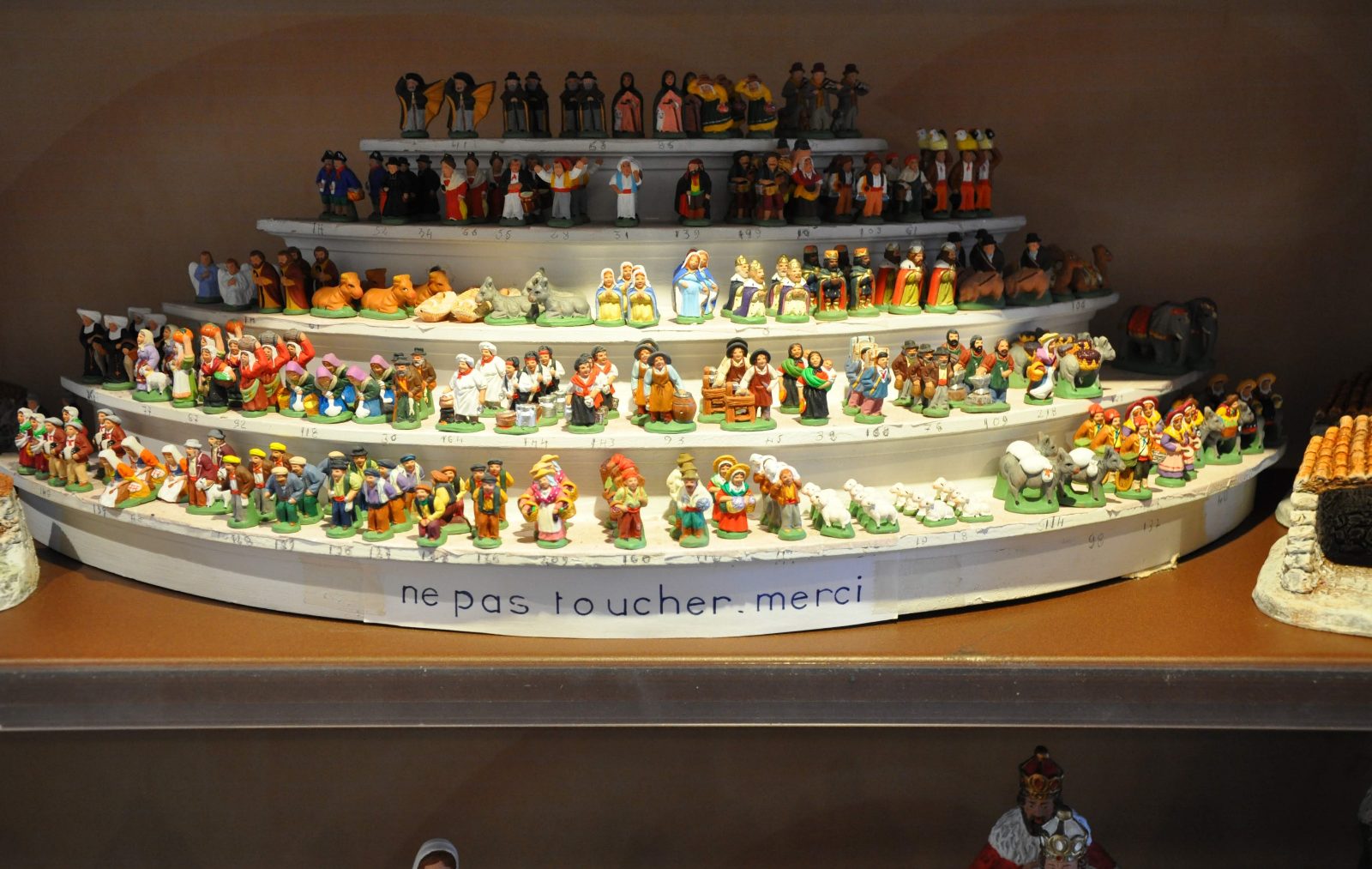
Examining a piece
It takes thirty seconds with the piece in your hand. The full version is in how to spot a good santon. Here’s the short one:
-
The eyes
Level with each other and looking the same way. Eyes are the hardest thing to paint and the easiest way to judge quality.
-
The mold seam
Run your finger along the sides. On a well-made piece, it’s been smoothed and you can’t feel it.
-
Crispness of the modeling
Compare two copies of the same character in the same bin. A worn mold makes soft folds and blurry faces.
-
The base
Set the piece on the counter. It should stand steady on its own. If it tips over on a flat surface, it’ll do worse on a hillside.
-
The sound
A fired santon rings clear when you tap it with a fingernail. A dull sound can mean a crack inside.
Questions to ask
These almost always get the maker talking, and you’ll learn more than any label can tell you:
- “Did you design this character yourself?” Almost every santon maker has one or two original characters. Those are the ones they love talking about.
- “How old is the mold?” A technical question that shows you know what you’re looking at.
- “Is it fired or unfired clay?” It affects how sturdy it is and how to care for it. See clay, plaster, fabric.
- “Will you still make this line in five years?” Key if you plan to add to it over time.
- “Do you do repairs?” Many do, and it’s good to know before the first break.
The pitfalls
- The box of thirty santons. Thirty lifeless figures, often from a worn-out mold, with no room left for the ones you’ll want later. Five carefully chosen santons are better.
- Buying before you pick a size. It’s the one decision you can’t undo. Read sizes first.
- Buying the Wise Men first. They’re beautiful and pricey, and they don’t arrive until Epiphany.
- Buying a tradesperson with no setting. A knife grinder in the middle of a field is just a figurine. In front of his workshop, he’s part of a scene. Plan the setting first.
- Mistaking shine for quality. Traditional santons are matte. Glossy varnish is a factory shortcut.
- Buying everything at once. A nativity that grows over ten years is more beautiful and tells your family’s story. See what order to buy them in.
We don’t list prices, because they vary too much by country, workshop and year. We also don’t recommend specific workshops: this site doesn’t rank craftspeople. What we can do is help you judge for yourself, and that’s what this page is for.